

The Candle Stand (1)
The first thing that every Orthodox Christian will do upon entering a
church is to kiss an icon and, then, light a candle. A symbol of the light
of Christ, this candle will be placed alongside other candles in a special
stand, a symbol of the community that characterizes the Body of Christ.
The candle stand on the right side of the narthex of the Church of St.
George is the center of profound prayer and daily devotion. Constructed
out of walnut and decorated with large ivory petals in the shape of a
pentagon, this seventeenth-century candle stand is a replica of early
Egyptian craftsmanship. The inscription cites that it was a gift by “Manuel,
son of Peter, from Kastoria, donated in the year 1669.”
The
Pulpit (2)
Wrapped around a column on the left side of the nave, the pulpit is attributed
by legend to the most famous preacher of the early Christian Church, St.
John Chrysostom (347–407), who preached many historical sermons
during his tenure as Patriarch of Constantinople. St. John was renowned
for his inspired homilies; hence his epithet “Chrysostomos,”
which means “the golden-mouthed.” Nevertheless, an inscription
inside the pulpit states that it was constructed during the tenure of
Gabriel III (1702–1707). The pulpit is made of walnut and mother
of pearl and is decorated with the motif of a vine. Though simpler, its
craftsmanship resembles that of the Patriarchal Throne.
The Patriarchal Throne (3)
The Patriarchal Throne in the middle of the nave is one of the most precious
and valuable artifacts of the Church of St. George. Legend attributes
the throne to the renowned Patriarch of Constantinople in the fourth century,
St. John Chrysostom (398–404). According to the inscriptions beneath
the eaves of the throne’s gables, it was a gift offered in 1577
by Patriarch Jeremiah II to the Patriarchal Church of Panagia Pammakaristos.
An inscription at the base of the throne recognizes it as the craftsmanship
of an Athenian artist, Laurentios.
The
throne stands four meters tall and is made of walnut. It is inlaid with
ivory, mother of pearl and colored wood, fashioned in the form of a vine.
In the past, it was also decorated with precious stones, but these are
no longer there.
According to a third inscription, on one of the gables over its eaves, the throne was damaged between 1652 and 1654 during the tenure of Patriarch Paisios I (1652–1653, and 1654–1655). It was renovated by Patriarch Iakovos (1679–1682). The damage probably caused the loss of numerous gems as well as two icons, which formerly decorated the throne. These two icons were: a) Christ the Pantokrator, or “All Ruler”; and b) the Descent into Hades and Burial of Christ. The latter icon is described by Malaxos in 1577; its exact position on the throne remains unknown. The present icon on the throne also depicts Christ the Pantokrator; it is not the original icon, but a replacement icon commissioned by Patriarch Paisios I.
The proper throne of the Ecumenical Patriarch is in fact the synthronon (see below). The prominent Patriarchal Throne in the middle of the nave is the traditional seat of the abbot. The Patriarch, therefore, sits here as head of the monastic brotherhood, of “The Great Monastery,” and may invite other, or visiting, hierarchs to officiate from this throne. On the two annual feasts of St. John Chrysostom—the commemoration of his repose on November 13 and the celebration of the transfer of his relics on January 27—the icon of St. John Chrysostom is placed on this throne, together with an episcopal staff, as though the Saint were presiding. On those days, the Ecumenical Patriarch is seated at the side-throne, or parathronion.
The Cantor’s Stalls (4)
Used by the cantors of the Ecumenical Patriarchate, the two stalls in
front of the iconostasis are among the artifacts transferred in 1942 to
the Phanar from the (former) Holy Convent of Panagia Kamariotissa (or
Koumariotissa) on the island of Halki. This island, well-known for its
theological school, also housed the Palmons Commercial School. The stands,
made of walnut and decorated with ivory, were renovated in 1947, as attested
to by an inscription on the base of the left stall.
In the tradition of the Ecumenical Patriarchate, the style of chanting in the Church of St. George is unique, conveying at once a sense of triumphant glory and prayerful simplicity.

The Iconostasis (5)
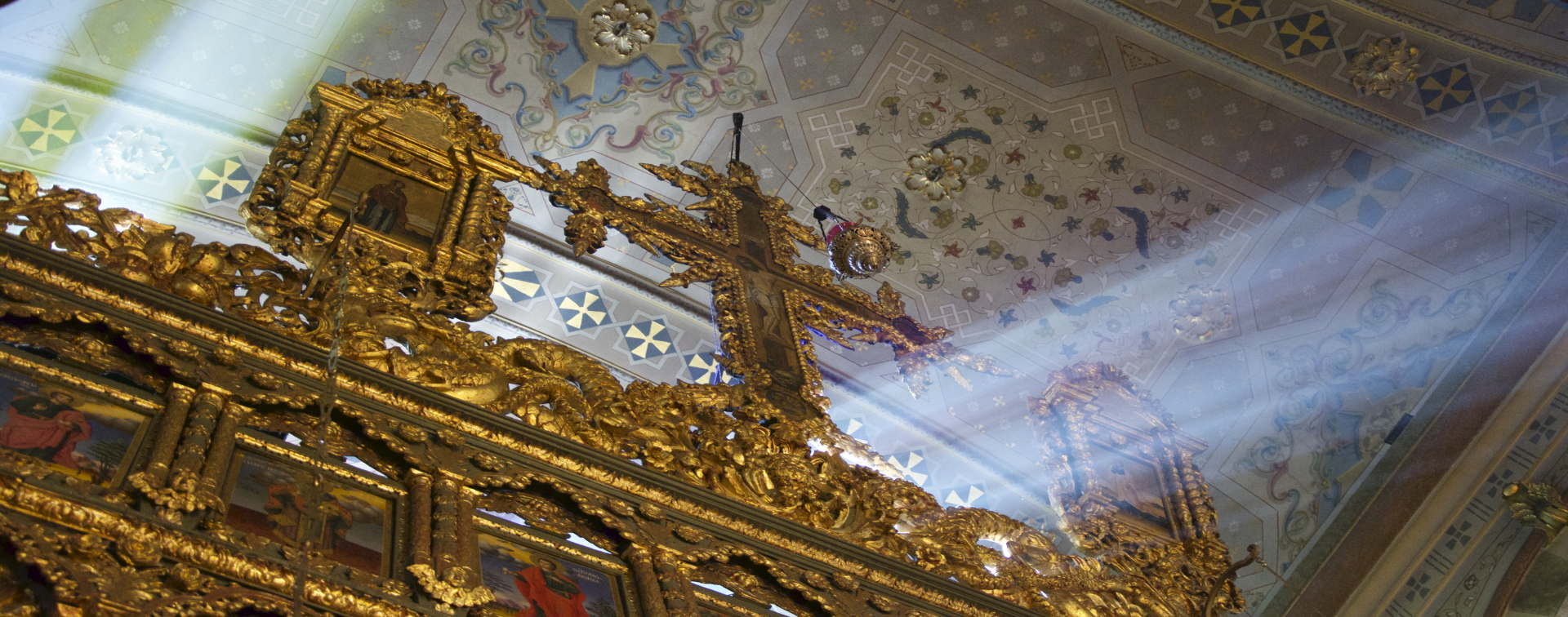
The screen of icons separating the nave from the altar space is known
as the iconostasis (or templon), which may range from a low, but ornate
railing to a full wall, ceiling to floor, normally depicting scenes form
the life of Christ, the martyrs, and the saints.1 The icon screen of the
Church of St. George does not adhere to any specific iconographic style,
resembling more a conglomeration of Byzantine and Renaissance, as well
as Baroque and even Ottoman influence. It is carved out of wood, which
was recently gilded. The icon screen is divided into three sections and
three levels. Smaller icons are placed before the icon screen itself in
order to render them more accessible for personal devotion and veneration.
The middle section of icons contains the Royal Doors in the center, with two small icons depicting the Annunciation (the Archangel Gabriel and the Theotokos on the top panels); the two small icons on the lower panels depict the renowned Archbishops of Constantinople, St. Gregory the Theologian (329–389) and St. John Chrysostom (c. 347–407).2 As visitors gaze at the icon screen, the right hand of the Royal Doors3 is the traditional position for the icon of Christ, in this case Christ enthroned as the Great High Priest and pictured as the “True Vine.” The traditional place for the icon of the Virgin Mother, or Theotokos, is on the left hand side of the Royal Doors. She is depicted here as the “Tree of Jesse,” manifesting the generations prior to the birth of Christ. Other traditional positions of icons include the depiction of St. John the Baptist, or Forerunner (normally beside the icon of Christ), as well as the icon of the saint or feast to which the church is dedicated (normally beside the icon of the Virgin Mother), in this case the icon of St. George the Great Martyr.
The northern (or left-hand) section4 is a chapel dedicated to the Three Hierarchs (St. Basil the Great, St. John Chrysostom and St. Gregory the Theologian, whose joint feast is commemorated on January 30). On the right side of the smaller gate, there is an icon of the Virgin Mother holding Christ and an icon of St. Nicholas. On the left side, there is an icon of the Three Hierarchs and a full-length icon of the Archangel Michael (traditionally also the northern door to the altar).
The southern (or right-hand) section is a chapel dedicated to the Supplication of Panagia Pammakaristos. On the right side of the smaller gate, there is a mosaic of St. John the Baptist and an icon of St. Euphemia. On the left side, there is an icon of the two Great Martyrs, St. George and St. Demetrios, as well as an icon of the Archangel Michael5 (traditionally also the southern door to the altar).
The two higher levels of icons include smaller panels depicting scenes and feasts from the New Testament (and especially the life of Christ) and the Old Testament (and especially from the life of the Prophets). They traditionally also depict the twelve Apostles of the Lord and the twelve major feast days of the Church.6 These icon panels are lowered for veneration on certain feast days.
The Synthronon (6)
Located within the holy sanctuary on the other side of the iconostasis,
behind the Holy Altar table, the synthronon consists of an elevated marble
throne surrounded by eleven smaller, wooden thrones. According to canonical
and liturgical tradition, only the Patriarch may be seated on the marble
throne, while the other thrones are reserved for bishops of the Holy and
Patriarchal Synod. This is in fact the proper throne of the Ecumenical
Patriarch. And, since some of the marble on the synthronon dates back
to the early fifth century, it may well have been graced by the presence
of St. John
Chrysostom.
The synthronon is an ancient liturgical practice of the Christian Church, symbolizing the unity of the faithful around the local bishop, who serves as president of the Eucharistic gathering. It is also symbolical of the collegiality of the body of bishops, chaired by the president of the local synod. The episcopal throne indicates the teaching authority of the bishop; the synthronon signifies the unity of love and faith that characterizes the Church.
The Icon of Panagia Faneromeni (7)
The icon of Panagia Faneromeni—literally, “the Mother of God,
who appeared”—is a painted icon located in the left aisle
of the church. This icon is honored for its miraculous properties. There
are numerous styles of depicting the Mother of God. Like the mosaic of
Panagia Pammakaristos (below), this particular icon depicts the Virgin
Mother as “Hodigitria,” which means “Directress”
because she is pointing to the child Christ. The icon was transferred
from Kizikos (present Kap›da€ in Turkey) and is overlaid with a gold
and silver cover, or shirt. The figures of Mary and Christ are quite worn.
The painting of the icon is estimated to date earlier than the Palaeologan
renaissance of the fourteenth/fifteenth centuries.
The Icon of St. John the Forerunner (8)
The icon of St. John the Forerunner, or John the Baptist, is located in
the right aisle of the church, on the right side of the iconostasis. It
is traditionally believed that the original site of this icon was in the
Church of Panagia Pammakaristos. This icon, too, is a mosaic and dates
back to the eleventh century. Together with the icon of Panagia Pammakaristos,
it predates the iconography found in Hagia Sophia and in the Monastery
of Chora.
St. John is depicted pointing (to the Son of God) and bearing a scroll, which reads: “Behold, the lamb of God, who takes away the sin of the world.”
The Icon of Panagia Pammakaristos (9)
The exquisite and rare mosaic icon of Panagia Pammakaristos (on the south
wall to the right of the iconostasis), which depicts the Mother of God
holding and pointing to the child Christ, was the patron icon of the ancient
Byzantine church of Panagia Pammakaristos, which formerly served as Patriarchal
church from 1486 to 1587. From there, the icon was transferred to each
of the subsequent Patriarchal churches in Constantinople, including the
present Church of St. George in the Phanar, where the icon has remained
since the beginning of the seventeenth century. Its artistic style dates
back to the late eleventh century, when the icon was created.
The Column of Christ’s Flagellation (10)
Located in the southeast corner of the nave, this column is one of the
most treasured and ancient relics of the Church of St. George. It is a
portion of the column where our Lord was bound and whipped by Roman soldiers
during His Passion and before His Crucifixion. Two other portions of this
column are preserved in Jerusalem and in Rome. It is said to have been
brought to Constantinople by St. Helen, the mother of Emperor Constantine,
after she visited the Holy Land.

The Relics of St. Theophano (11)
Like icons, relics are a central aspect of Orthodox Christian worship.
The theology of relics is grounded in the Orthodox doctrine of deification,
or theosis, namely the sanctification of the entire human person—body
and soul. They underline the fullness of the transfiguration of the material
world by divine grace and serve as a reminder of the essential unity between
the living Church and the Church triumphant. They are normally enshrined
in elaborately crafted containers, or reliquaries, displayed for veneration
and commemoration by the faithful.
Evidence for the preservation and veneration of sacred relics dates back to at least the mid-second century. Popular veneration of relics further contributed to the unity of the Church during the Byzantine era. The relics of three women saints of the Church are preserved intact in a row of reliquaries to the right of the Column of Flagellation. Those of St. Theophano are in the first reliquary.
St. Theophano the Empress came from a devout and noble family of Constantinople. She married Leo, an heir to the Byzantine Throne. Leo became known as Leo the Wise (886–911). Remarkably, while St. Theophano was born into an aristocratic house and married into the imperial palace, she always led an ascetic life. Hymnography recalls how she renounced earthly riches, leading instead a life of prayer and almsgiving. St. Theophano is commemorated on December 16.
The Relics of St. Euphemia (12)
St. Euphemia, whose relics are in the middle reliquary, was born in Chalcedon
(present-day Kad›köy), the daughter of devout parents, Philophron
and Theodosiani. She was tortured during the persecutions of Emperors
Diocletian and Maximian in the late third century. The Saint played a
major role in inspiring the Fathers of the Fourth Ecumenical Council.
During that council (451), St. Euphemia worked a miracle that determined
the final doctrinal definition. The 630 Fathers, who gathered for this
council in Chalcedon, were deliberating about the two natures of Christ.
Eutyches and Dioscoros claimed that Christ possessed only a single nature.
To test this teaching, the Holy Fathers inscribed the differing opinions
on two separate decrees, which they placed inside the reliquary of St.
Euphemia. When the reliquary was later opened, the decree of the heretics
had fallen to the feet of the Saint, while the Orthodox doctrine rested
in her hands. The Orthodox Church celebrates this miracle on July 11.
The repose of St. Euphemia is commemorated on September 16.
According to her biography, the relics of St. Euphemia adorned many churches of Constantinople prior to its conquest in the fifteenth century. Thereafter, the relics were successively relocated to each of the Patriarchal churches. The icon of St. Euphemia records scenes from the life, martyrdom, and miraculous interventions of the Saint.
The Relics of St. Solomone (13)
St. Solomone, whose relics lie in the last reliquary on the right, was
of Jewish ancestry, being the mother of the seven Maccabees—Abheim,
Antonios, Gourias, f numerous Christian martyrs, who suffered torture
at the hands of the State in the name of Christ. St. Solomone is commemorated
on August 1.
Historians have suggested that the relics do not in fact belong to Solomone, since she was burned to death, being thrown into a fire with the Seven Maccabees. The relics probably belong to Mary Salome, one of the women who stood at the foot of the crucified Christ and one of the Myrrh-Bearing Women.
The Relics of St. Gregory the Theologian and St. John Chrysostom (14)
One of the most important Church Fathers, St. Gregory the Theologian (329–390)
delivered five Theological Orations on the Holy Trinity and prepared the
way for the triumph of orthodoxy during the Second Ecumenical Council
(381), which completed the Symbol of Faith, also known as the [Nicean-Constantinopolitan]
Creed. Regarded as the greatest of preachers, St. John Chrysostom (c.347–407)
is one of the most beloved Church Fathers in both East and West. His sermons
On the Priesthood remain formative reading on the ministry. The relics
of these two saints were taken to Rome after the Fourth Crusade in 1204,
where they remained for 800 years. In November 2004, the sacred relics
of the two renowned Archbishops of Constantinople were solemnly restored
to the Ecumenical Patriarchate (see page 56). They are now treasured in
hand-carved marble reliquaries at the mid-point of the north wall of the
nave of the Church of St. George.
1 In other parts of the church, certain icons also contain biographical miniatures of the saint depicted, as in the icons of St. George, St. Nicholas, and St. Spyridon.
2 Relics of these two Saints were returned to the Ecumenical Patriarchate from the Vatican at the initiative of Ecumenical Patriarch Bartholomew I in November 2004.
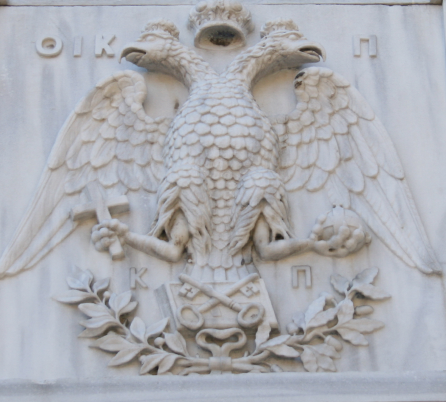
3 The small gates opening from the iconostasis into the altar contain the symbolical double-headed eagle, a sign reminiscent of the close relationship between Church and State in the Byzantine Empire. Later theological interpretation attributes the two natures of Christ, divine and human, to this symbol. The same symbol is prominent on the facade of the Patriarchal church and elsewhere. Formerly an emblem of the Byzantine Empire, it now serves as an emblem of the ecumenical breadth-east and west, even as the eagle looks in both directions-of the Ecumenical Throne.
4 Architecturally, Orthodox churches traditionally face eastward, symbolical of the expectation and anticipation of the rising of the Sun of Righteousness, the Son of God, namely Jesus Christ.
5 The Patriarchal church is unique in this regard, having two icons of the Archangel Michael. Normally, one side of the icon screen (traditionally, the northern door) depicts the Archangel Gabriel, while the other side (traditionally, the southern door) depicts the Archangel Michael.
6 In the Patriarchal church, there appears to be no particular theological or liturgical sequence to the icons in the upper two levels of the icon screen, although the topmost level depicts predominantly individual saints, while the middle level contains icons with multiple saints or festive days.

Watch the historic interview with CBS correspondent Bob Simon now » Learn More »
Learn the history of the Theological School of Halki since its establishment in 1844. Learn More »
YouTube: Subscribe to the GreenPatriarch channel (on the Environmental Symposia) or the Ecumenical Patriarchate channel (on the US visit).
Tuesday, June 08, 2010
Inasmuch as, at the Ecumenical Patriarchate, we have long been concerned about problems related to the preservation of the natural environment, we have ascertained that the fundamental cause of the abuse and destruction of the world’s natural resources is greed and the constant tendency toward unrestrained wealth by citizens in so-called “developed” nations. Read more...
Please enter a search term to begin your search.